 Final
4 March 1972
Wembley Stadium,
London
Attendance: 97,852
Referee: N. Burtenshaw
Stoke City, the second oldest club in the Football League (they were founded in 1863), at last walked off with a major soccer trophy for the first time in their 109-year history when they beat Chelsea in the 1972 League Cup Final at Wembley. Their only other Cup Final appearance was in the 1964 League Cup contest when they were beaten by Leicester City. Ironically Chelsea, their 1972 opponents, also did battle with Leicester City in the 1965 Final and their eventual win brought the League Cup to Chelsea for the first time.

Stoke City, under the expert managership of Tony Waddington, have proved themselves a great Cup-fighting force. They are an attractive soccer unit with skill and the determination to match. This determination to win was never more evident than in the 1971-72 League Cup and F.A. Cup competitions. Their road to the League Cup Final involved them in eleven matches. Four of these were against West Ham in the Semi-Final, and three games against Manchester United in the fourth round. Their duel with West Ham was truly a classic affair which began with a home defeat for Stoke in the first match by a goal to nil but in the return at West Ham they won by the single goal. There followed a replay which ended in a 0-0 draw but in the fourth meeting West Ham succumbed to Stoke by three goals to two. Over 170,000 people watched these four great games. Stake's three-match clash with Manchester United, resulting in two draws—1-1 (at Manchester), 0-0 (at Stoke)-with a 2-1 victory for Stoke in the second replay, was watched by over 130,000 fans. Stoke's other victims on the way to Wembley were Southport (second round), Oxford United (after a replay in the third round) and Bristol Rovers (fifth round).

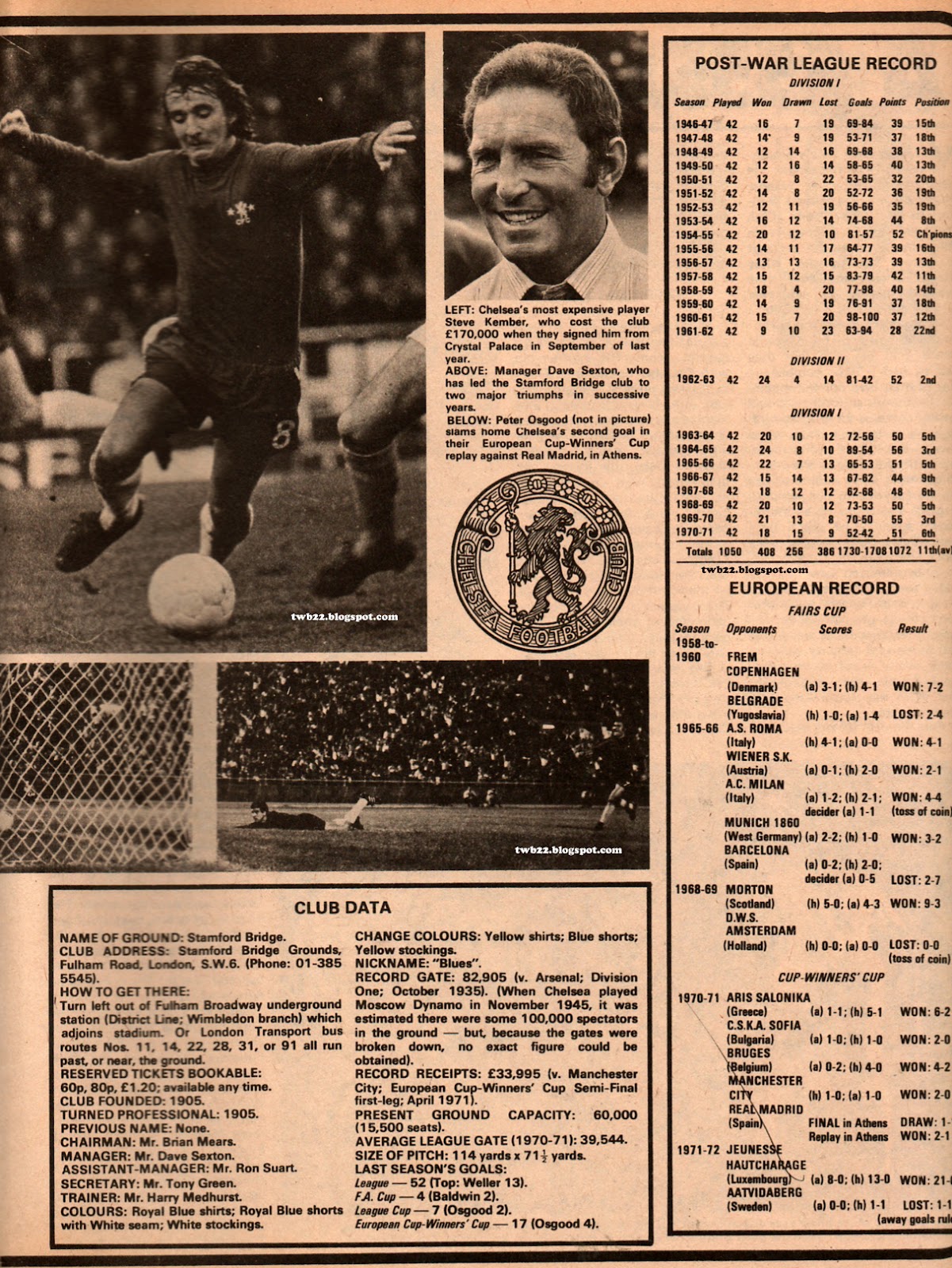
Chelsea's route to the Final involved them in eight games. Plymouth were their first victims, then came Notts Forest (after a replay in the third round), Bolton (after a replay in the fourth round), Norwich (fifth round) and the two-match Semi Final against Spurs whom they beat on a 5-4 aggregate. The Final itself began in a sensational way. The game was just four-and-a-half minutes old when Stoke struck the first blow. A throw-in by Peter Dobing led to a goalmouth scramble and shots by Terry Conroy and Denis Smith were blocked, but Conroy got his head to the ball to put it into the Chelsea net. A great start for Stoke City. Just when it looked as though Stoke would go into the dressing-room a goal up at half-time Chelsea came back into the match with a Peter Osgood goal a few moments before the whistle. Chelsea had created many chances for a goal but their forwards lacked the ability to press home their goal chances and the tough, resolute Stoke defenders stood firm. Then came the Osgood goal scored at the perfect psychological moment before Stoke could hit back. Would Chelsea now take the initiative in the forty-five minutes remaining? The second-half began with Chelsea on top, and with Alan Hudson and Chris Garland in great form. But the goals would not come for Chelsea. In the seventy-fourth minute, George Eastham, that skilful veteran of the Stoke side, settled the issue with an historic goal and his first in two seasons. Eastham, 35, was playing in his first Wembley Cup Final, and not even he in his wildest dreams could have dreamed it was to be his goal that was to win Stoke their first major Cup.

The goal move that took the Cup to the Potteries started out of defence. Peter Dobing relieved Chelsea pressure on his defence by starting a quick Stoke offensive with a long sweep of the ball to Terry Conroy. Conroy then found John Ritchie unmarked by the far post with a precision cross. Ritchie headed the ball down across the face of the goal to the waiting Jimmy Greenhoff who shot hard and low. The hall hit 'keeper'Peter Bonetti then bounced up. Dobing and Eastham rushed in, Eastham shouting to Dobing, 'leave it', and then coolly crashed it home for the winner. It must have been an emotional moment for the fair-haired George, born in Blackpool. His soccer career has been a topsy-turvy one. It began in Northern Ireland. In 1956, he signed for Newcastle. In 1960 he moved to Arsenal amid great controversy. In 1963 he got his first England cap against Brazil at Wembley and George was to play an important role in a new style England team introduced by Alt Ramsey. But George was eventually to lose his England spot to Martin Peters for the World Cup which England went on to win with a victory against West Germany at Wembley.

Eastham's playing days with Arsenal were also to come to an end. He was transferred to Stoke for £30,000, where this exciting schemer was to become part of manager Tony Waddington's plan to re-build a side which had much talent at its disposal. With the skills of Jimmy Greenhoff, bought from Leeds, John Ritchie and Peter Dobing, Stoke had attacking power which almost got them into the 1971 Cup Final. In the Semi-Final they were leading Arsenal 2-1 but Gordon Banks gave away a penalty in injury time from which Arsenal equalised, and Arsenal went on to win the replay, the Cup and the Double. Ironically Stoke again fell victims to Arsenal in the Semi-Final of the F.A. Cup in 1972. In the close season of 1971 Eastham went to South Africa but came back to Stoke City. His individual skill and highly intelligent reading of the game have played a major part in Stoke's success story. George Eastham must have been the proudest and happiest man of them all in that huge 100,000 crowd at Wembley on March 4, 1972 . . . the day when Stoke City, at last, won a major soccer trophy. But they can also thank their brilliant skilful 'keeper Gordon Banks for keeping Chelsea at bay, particularly in the dying moments when he brought off two miraculous saves from Peter Osgood, and Chris Garland, who pounced on an agonising back pass from Mike Bernard only to be deprived of a certain goal by the split-second timing of Banks who came out of his goal to smother the ball at Garland's feet.

STOKE CITY - Banks; Marsh, Pejic, Bernard, Smith, Bloor, Conroy, Greenhoff, Ritchie, Dobing, Eastham (Substitute: Mahoney).
CHELSEA - Bonetti; Mulligan, Harris, Hollins, Dempsey, Webb, Cooke, Garland, Osgood, Hudson, Houseman (Substitute: Baldwin).


Codec H264,
Mkv
Bitrate 1000
Sound 128 kbps
English Comments
Resume
Bitrate 1000
Sound 128 kbps
English Comments
Resume




Caps


